
Why Salesforce Stops Delivering ROI After Go-Live
February 11, 2026
A Decision Framework for Enterprise Leaders
March 31, 2026
Salesforce AI readiness is becoming a critical strategic priority for enterprise organizations. Artificial Intelligence is rapidly becoming embedded into enterprise CRM strategy. According to Gartner, over 80% of enterprises are investing in AI-enabled business applications. Salesforce Einstein, predictive CRM, intelligent automation, and AI-driven analytics are positioned as accelerators of revenue growth and operational efficiency.
Yet industry data consistently shows that a large percentage of CRM AI initiatives fail to generate measurable ROI.The reason is not technological limitation. It is structural unreadiness. Before activating Salesforce AI capabilities, enterprises must assess whether their CRM environment can actually support intelligent systems. AI does not fix operational weaknesses. It exposes them.
The Research: Why CRM AI Underperforms
Recent industry studies indicate:
• 60–70% of CRM implementations underperform post go-live
• 40% of enterprise data remains incomplete or poorly structured
• Less than 50% of CRM users consistently follow standardized processes
• AI initiatives fail primarily due to poor data quality and lack of governance
Artificial Intelligence models rely on historical accuracy. If opportunity stages are inconsistent, if lead fields are incomplete, if customer records are fragmented across systems , predictive models will produce unreliable outputs. AI amplifies data maturity. It does not replace it.
The Real Enterprise Risk: AI Without Readiness
Deploying Salesforce Einstein without proper Salesforce AI readiness creates three strategic risks::
- False Predictive Confidence
Executives begin making decisions based on flawed AI outputs.
- Erosion of User Trust
Sales and service teams stop relying on CRM intelligence when recommendations feel inaccurate.
- Escalating Technical Debt
Quick AI enablement without governance creates automation sprawl, unmanaged workflows, and system fragility.
Enterprises that rush into AI activation often experience declining CRM ROI instead of growth acceleration.
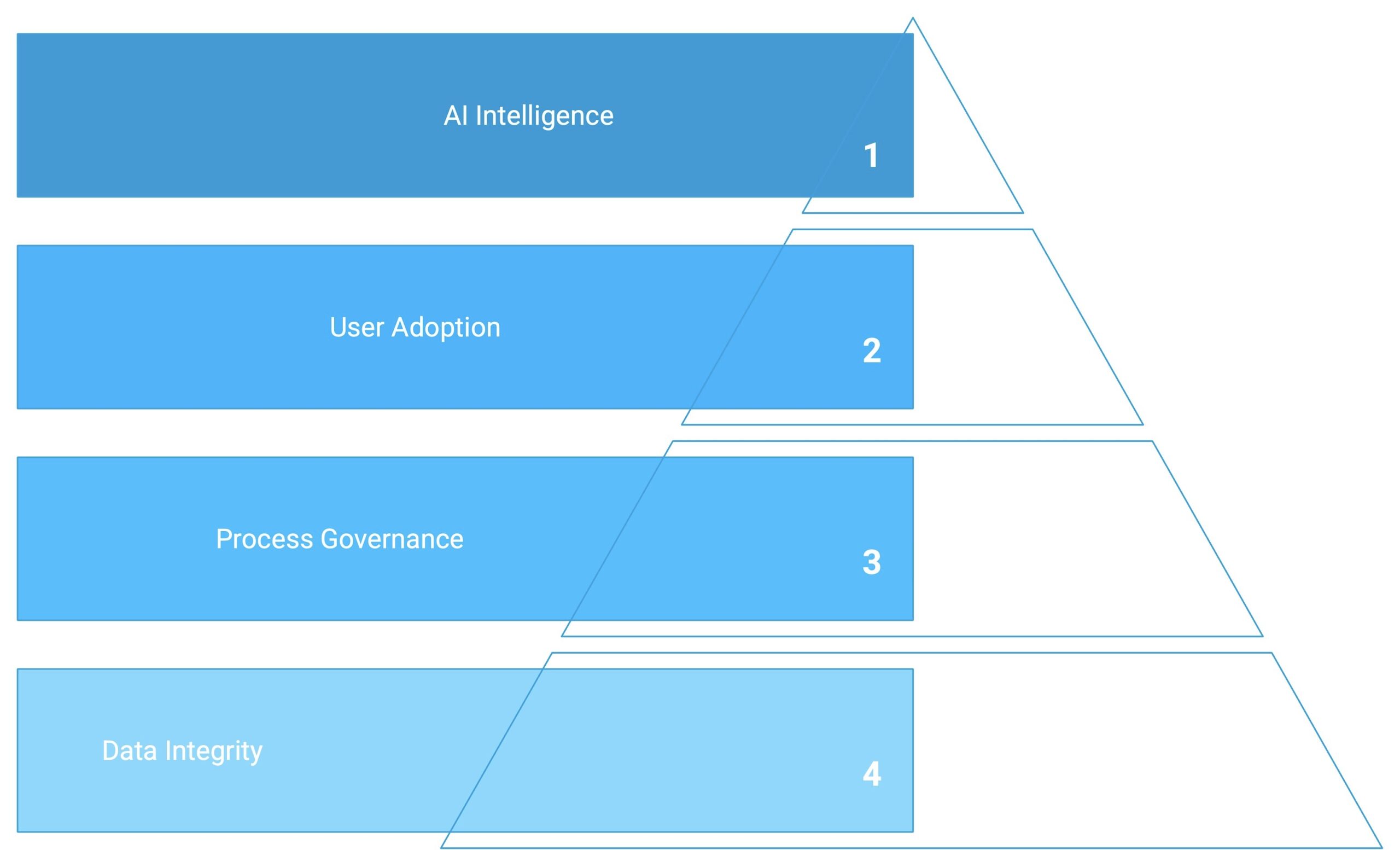
The Salesforce AI Readiness Framework
A structured Salesforce AI readiness assessment helps enterprises evaluate whether their CRM ecosystem can sustain predictive intelligence.
1. Data Integrity and Integration Stability
AI accuracy is directly proportional to data quality.
Mature organizations ensure:
• Standardized field definitions
• Duplicate prevention controls
• Unified customer records
• Clean historical opportunity data
• Reliable integration architecture
Research shows that predictive models improve by up to 35% when structured data hygiene programs are implemented prior to AI deployment.
Without structured, validated data, Salesforce AI cannot deliver reliable forecasting or intelligent scoring.
2. Process Maturity and Workflow Discipline
Artificial Intelligence optimizes structured processes.
Enterprises must evaluate:
• Lead qualification criteria consistency
• Sales stage alignment across business units
• Service lifecycle definitions
• Escalation protocols
• SLA tracking mechanisms
AI improves processes that already exist. It cannot compensate for undefined or inconsistent workflows.
3. Adoption Stability and Behavioral Data Capture
AI systems learn from user behavior patterns.
If CRM adoption is low, predictive systems lack sufficient behavioral signals.
Organizations should measure:
• Active Salesforce usage rates
• Data entry compliance
• Automation interaction rates
• Dashboard utilization
High-performing enterprises ensure adoption maturity before layering predictive intelligence.
Practical Enterprise Solutions Before AI Activation
Improving Salesforce AI readiness before activation reduces long-term technical debt and strengthens forecasting reliability. Instead of immediately enabling Salesforce AI features, enterprises should implement a phased readiness roadmap:
Phase 1: Data Audit
Conduct CRM data quality assessment. Clean duplicates. Standardize mandatory fields.
Phase 2: Workflow Standardization
Align opportunity stages. Define automation ownership. Remove redundant flows.
Phase 3: Governance Framework
Assign accountability for CRM architecture. Implement change control mechanisms.
Phase 4: AI Pilot Deployment
Activate predictive lead scoring or forecasting within a controlled business unit before enterprise-wide rollout.
Organizations that follow structured AI activation report:
• Higher predictive accuracy
• Stronger CRM adoption
• Improved sales forecasting reliability
• Reduced technical debt accumulation
Real Enterprise Example Scenario
Consider a mid-sized financial services firm enabling Salesforce Einstein lead scoring without prior data governance.
Result:
• AI recommendations were inconsistent
• Sales teams ignored system scoring
• Leadership lost confidence in predictive dashboards
After implementing data standardization, stage alignment, and governance oversight:
• Lead conversion increased by 18%
• Sales cycle reduced by 12%
• Forecast accuracy improved significantly
The difference was not technology.
It was readiness.
Strategic Takeaway
AI inside Salesforce is not a feature toggle.
It is an enterprise capability.
The organizations generating measurable ROI from Salesforce AI share common traits:
• Clean, structured CRM data
• Process alignment across departments
• High user adoption
• Governance accountability
• Measured rollout strategy
The true competitive advantage does not come from enabling AI first.
It comes from preparing the CRM ecosystem to sustain it.
Conclusion
Before enabling AI features, enterprise leaders must evaluate their Salesforce AI readiness maturity.Is our CRM operationally mature enough to support intelligent automation and predictive analytics?
Artificial Intelligence is powerful.But only when built on disciplined foundations.