

From Data to Decisions: How Banks Are Re-Architecting CRM for the Age of AI
November 21, 2025
Is Your Salesforce Ready for AI? A Practical Readiness Framework for Enterprises
February 27, 2026
For many enterprises, Salesforce go-live feels like the finish line. However, without structured Salesforce ROI consultation, measurable value rarely sustains beyond implementation. The system is deployed, users are trained, dashboards are live, and leadership expects returns to follow automatically. Yet within months, ROI begins to fade. This pattern illustrates Why Salesforce Stops Delivering ROI After Go-Live. This is not a Salesforce problem. It is a post–go-live problem. Across industries, a large percentage of CRM programs underperform after implementation because organizations treat go-live as completion rather than transition. The real value of Salesforce is realized after deployment, not during it.
The Go-Live Myth
Go-live is often misunderstood as success. In practice, it is only the point where technical delivery ends and business responsibility begins. Most CRM programs are built to satisfy initial requirements but are not designed to evolve with real usage patterns. This misunderstanding is a core reason Why Salesforce Stops Delivering ROI After Go-Live.
Once real users begin working inside Salesforce, gaps appear quickly. Processes feel rigid, fields multiply without purpose, reports lose trust, and teams quietly return to spreadsheets or side tools. ROI does not disappear overnight. It erodes gradually.
Where ROI Starts to Leak
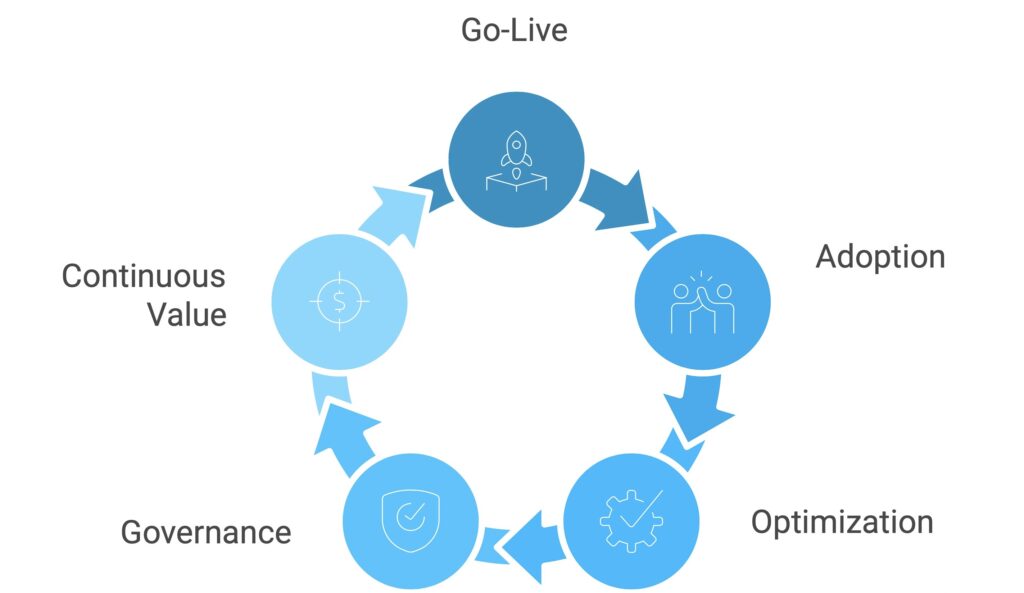
The decline in value typically follows a predictable pattern.
First, user adoption weakens. Users were trained on how the system works, not how it fits into their daily decisions. Salesforce becomes a compliance tool rather than a productivity engine. Second, governance weakens. New fields, flows, and automations are added reactively. No one owns design discipline. Over time, the system grows complex, inconsistent, and fragile.
Third, technical debt accumulates. Customizations made under time pressure remain forever. Integrations are left undocumented. Performance degrades. Enhancements become expensive and risky. Finally, leadership loses confidence in data. Dashboards look impressive but do not answer real questions. Decisions move outside Salesforce, and ROI becomes impossible to measure. Moreover, this explains Why Salesforce Stops Delivering ROI After Go-Live for many companies.
Adoption Is a Strategy, Not a Training Session
Most organizations treat adoption as a one-time activity during rollout. In reality, adoption is an ongoing design problem. Users adopt systems that reduce friction, not systems that require discipline. High-performing Salesforce programs continuously refine user journeys. They simplify screens, remove unused fields, align flows with real processes, and design dashboards around decisions rather than metrics. Adoption improves when Salesforce feels helpful, not mandatory.
Governance Determines Longevity
Governance is the most overlooked factor in CRM success. Without clear ownership, Salesforce becomes a shared workspace with no design authority. Every team adds what they need, and no one removes what is no longer relevant. Strong governance does not mean bureaucracy. It means clear rules for when to configure, when to customize, and when to integrate. It means reviewing changes for long-term impact, not short-term convenience. Enterprises that sustain ROI treat Salesforce as a product, not a project.
Optimization Versus Rebuild
When ROI drops, many organizations assume the system is broken and consider rebuilding from scratch. This is rarely necessary. In many cases, a focused Salesforce ROI consultation can identify design inefficiencies, automation overload, and governance gaps without requiring a full rebuild.
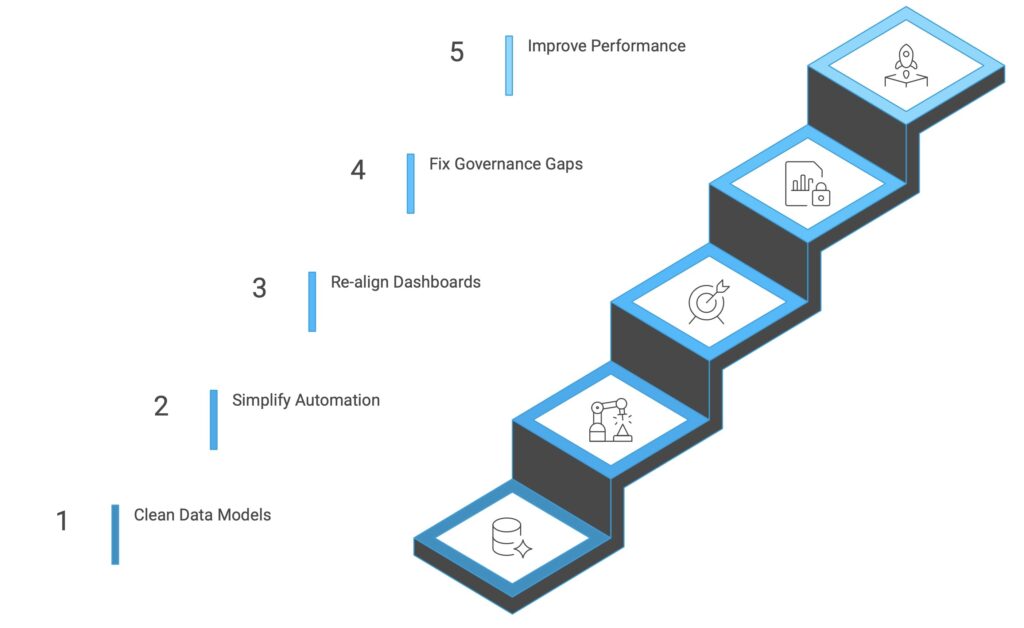
In most cases, value can be restored through structured optimization:
- Cleaning data models
- Simplifying automation
- Re-aligning dashboards with business goals
- Fixing governance gaps
- Improving performance and usability
A rebuild is only justified when the original design fundamentally conflicts with the business model or when technical debt has reached a point where change is no longer safe. Knowing the difference between optimization and rebuild is critical to controlling cost and time. Enterprises that recover Salesforce ROI follow a few consistent principles. They measure success beyond usage metrics and focus on outcomes such as cycle time, decision quality, and productivity. In short, understanding Why Salesforce Stops Delivering ROI After Go-Live can guide organizations to better strategies.
The Enterprise Fix Strategy
They review Salesforce quarterly, not annually, treating optimization as continuous improvement. and align CRM ownership with business leadership, not just IT. They invest in design, governance, and analytics with the same seriousness as initial implementation. Most importantly, they accept that Salesforce is never finished.
Enterprises that prioritize ongoing Salesforce ROI consultation treat the platform as a long-term asset rather than a one-time project.
Final Thought
Salesforce does not fail after go-live. Programs fail when organizations stop evolving the system alongside the business. Go-live is not the end of the journey. It is the point where ROI responsibility shifts from implementation teams to enterprise leadership. The organizations that understand this early are the ones that turn Salesforce from a deployed platform into a long-term growth engine. Indeed, taking time to learn Why Salesforce Stops Delivering ROI After Go-Live is essential for any enterprise aiming for true value.