

Is Your Salesforce Ready for AI? A Practical Readiness Framework for Enterprises
February 27, 2026
For many enterprise organizations, Salesforce is no longer a new investment. The real challenge is deciding between Salesforce optimization vs reimplementation as systems mature and complexity increases. Over time, however, a difficult question begins to surface in executive conversations.
Should we optimize what we have, or should we re-implement Salesforce from scratch?
This question rarely arises out of curiosity. It typically emerges under cost pressure, declining adoption, legacy customization, unreliable reporting, and growing technical debt. CIOs and digital transformation leaders often face this dilemma when incremental fixes stop delivering proportional value.
Making the wrong decision can be expensive. Making the right one can unlock the next phase of enterprise growth.
Why This Question Arises in Enterprise Environments
As Salesforce environments mature, complexity increases. What begins as a structured CRM implementation gradually accumulates layers of customization, automation rules, integrations, third-party applications, and process-specific modifications. Business models evolve faster than architecture. Mergers and acquisitions introduce new data structures. Teams build workarounds to meet urgent needs. Over time, friction becomes visible.
This is where the debate around Salesforce optimization vs reimplementation becomes critical for enterprise leaders. Reporting loses credibility because definitions vary across teams. Automation overlaps or conflicts. Sales users revert to spreadsheets. Service teams bypass workflows. Marketing exports data externally. When user trust declines, Salesforce shifts from being a growth engine to becoming a compliance system.
At the same time, leadership expectations increase. Organizations want predictive forecasting, agent-driven automation, real-time personalization, unified customer intelligence, and measurable AI-driven performance. When legacy architecture cannot support these ambitions, optimization versus re-implementation becomes a strategic decision.
When Salesforce Optimization Is the Smarter Move
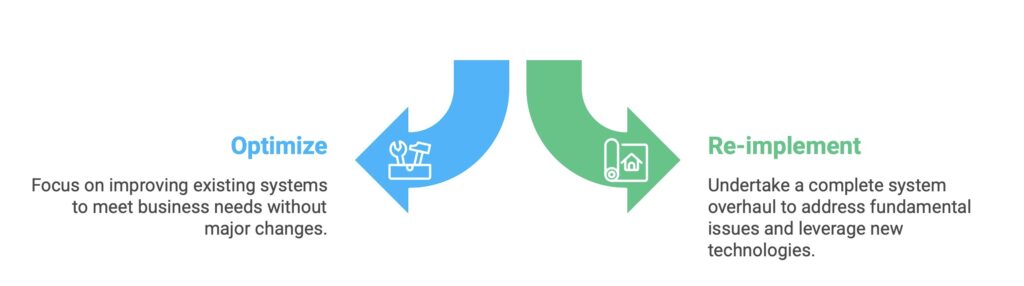
Optimization is often the right path when the structural foundation remains sound but underutilized.
If the core data model still reflects how the organization sells and serves, if integrations are stable, and if customization is manageable rather than deeply entangled, then targeted optimization can deliver strong ROI without disruption.
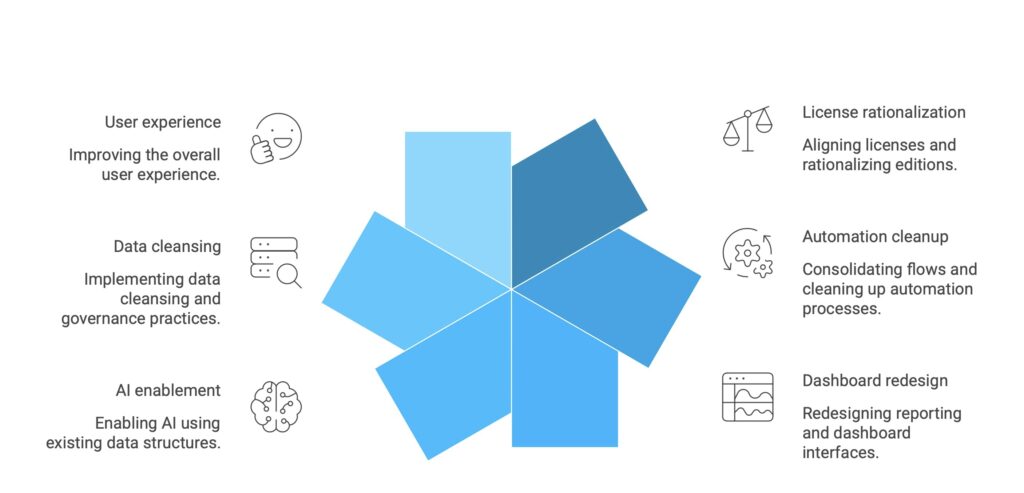
In these environments, common optimization initiatives include:
- License rationalization and edition alignment
- Automation cleanup and flow consolidation
- Reporting and dashboard redesign
- AI enablement using existing data structures
- Data cleansing and governance implementation
- User experience improvements
Optimization typically delivers faster results, requires lower investment, and minimizes operational risk. It is especially effective when performance gaps stem from configuration inefficiencies rather than structural misalignment. However, optimization cannot repair foundational architectural flaws.
When Salesforce Reimplementation Becomes Necessary
Re-implementation is a strategic reset, not a cosmetic refresh. It should be considered when structural misalignment creates long-term risk.
Common warning signs include:
- The original implementation no longer reflects the current business model
- Heavy undocumented Apex customization makes changes risky
- Automation logic is fragmented and difficult to troubleshoot
- Reporting cannot be trusted due to inconsistent data structures
- Multiple third-party apps duplicate native capabilities
- Data quality issues are systemic rather than isolated
- AI initiatives repeatedly fail due to fragmented architecture
- User adoption remains low despite training and incentives
If your Salesforce environment requires constant workarounds to support core processes, the issue may not be inefficiency. It may be architecture.
Re-implementation provides the opportunity to redesign the data model, eliminate technical debt, rationalize integrations, standardize automation frameworks, and create an AI-ready unified environment. While it demands higher upfront investment and disciplined change management, it can restore long-term scalability and innovation capacity.
Cost and Risk Comparison
Enterprise leaders must weigh both financial and operational implications.The decision between Salesforce optimization vs reimplementation should be based on structural health, not temporary frustration.
Optimization offers lower upfront cost, shorter timelines, minimal disruption, and faster visible ROI. It reduces waste and improves system performance without destabilizing the organization. Re-implementation requires higher initial investment and longer transformation timelines. It introduces temporary operational complexity but enables deeper structural correction and stronger long-term scalability.
The real risk lies in optimizing a broken architecture repeatedly. Over time, incremental fixes can exceed the cost of a controlled rebuild. Conversely, rebuilding when optimization would suffice wastes capital and creates unnecessary instability. The decision must be based on structural health, not frustration level.
A Practical Enterprise Decision Framework
To reduce ambiguity, enterprise leaders should evaluate five core dimensions.
First, assess architectural integrity. Does the data model align with the current business model? Are integrations modular and maintainable? Is automation organized or fragmented?
Second, evaluate AI readiness. Can the current environment support predictive analytics, agentic workflows, real-time personalization, and advanced automation without structural redesign?
Third, quantify technical debt. How much undocumented customization exists? How difficult is change management? Do overlapping workflows create hidden risk?
Fourth, analyze cost trajectory. Are license and third-party costs rising without measurable productivity gains?
Fifth, assess organizational readiness. Is executive leadership aligned around transformation? Can the business absorb phased disruption if necessary?
These dimensions collectively clarify whether optimization is sufficient or whether re-implementation is strategically justified.
The Hybrid Approach: Often the Smartest Path
In many enterprise cases, the answer is not binary. A structured architectural audit can reveal immediate optimization opportunities while identifying deeper structural risks. Organizations may stabilize performance through short-term optimization and then execute targeted re-implementation of high-risk domains.
This phased approach reduces financial risk while preserving long-term flexibility. Ultimately, choosing Salesforce optimization vs reimplementation determines whether the platform becomes a growth engine or a long-term liability.
Final Thoughts on Salesforce Optimization vs Reimplementation
Complexity in enterprise systems is natural. The critical question is not whether your Salesforce environment feels complicated. The real question is whether it supports your future strategy.
If your CRM is slowing innovation, blocking AI, and increasing cost without increasing value, structural evaluation is necessary. If your CRM remains strategically aligned but operationally inefficient, disciplined optimization may unlock significant returns. Salesforce should not be a cost center. It should function as an intelligent growth engine.
The decision to optimize or re-implement must be architectural, financial, and strategic. When evaluated correctly, it becomes one of the most important technology decisions shaping enterprise competitiveness in the AI era.